
It’s been a while since I posted here; it’s been a very busy year.
However, I had been writing about a theme of “self-hosting”, providing computer and Internet services for yourself, rather than relying on the “FAANG” to do it for you.
This blog has been an example of dependence on the FAANG, being hosted on GitHub Pages (which belongs to Microsoft). While I have no complaints about the service that they provided, I felt a certain unease about using it for several reasons, including the following:
- I was relying on services and functions that could change at any time, with or without notice, and without consideration of what inconvenince any such change might impose on users such as myself (but of course I could ask for my money back).
- By placing my data on other’s computers, it is obvious that there are privacy implications. For a blog such as this, these seem negligible, since the point of a blog is to publish after all. But for other applications, these concerns are quite real, and while they can be mitigated by using techniques such as end-to-end encryption, its implementation is often non-trivial and risky.
- By making use of such a platform, I am implicitly endorsing or promoting it, when this is not my intent, particularly when I frequently object to technical methods and approaches used by it.
- As the FAANG companies become larger and larger and wealthier, their executives become more and more powerful and politically influential, in areas that have nothing to do with their core business. I have no objection to anyone engaging in politics; I only object to involuntarily funding such activities.
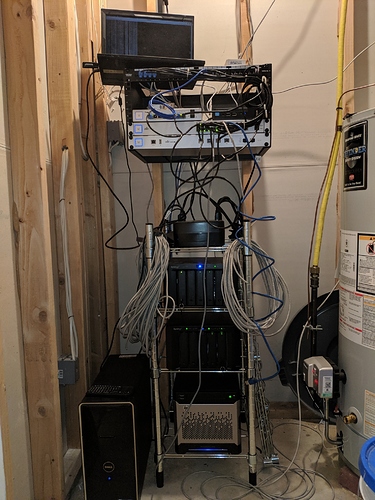
After several weeks of tinkering in the margins, I have finally gotten something stood up that moves this blog considerably closer to being self-hosted. While the “source code” for the blog remains in a git repo hosted on GitHub, the creation and hosting of the web site is now performed on my own hardware, on my own network at home.
Of course such an implementation is less reliable and resilient than something in the public cloud, but for my purposes, it is more than dependable enough for my purposes and audience.
Another valuable result of going through this exercise is to push back against the public cloud marketing juggernaut, that constantly argues that there is no choice to go to the cloud. Critics of this frequently point out that before the advent of the public cloud, people built their systems, networks, and services using their own hardware and open-source software; the very same tools that were used to implement the earliest versions of the public cloud. It seems odd then to receive suggestions that it is no longer possible to do the very things that everyone used to do.